
Abstract
The CAFA Unmanned Ground Vehicle (UGV) (link: https://cafatech.com/ugv) represents a significant advancement in autonomous systems for industrial safety applications. This article examines the technical specifications, operational capabilities, and artificial intelligence integration of this robotic platform, with particular focus on its novel application in electric vehicle (EV) battery risk assessment. The system’s multimodal sensing suite, machine learning architecture, and remote operation framework demonstrate how autonomous robotics can enhance safety protocols while maintaining operational efficiency in complex environments.
Technical specifications and design
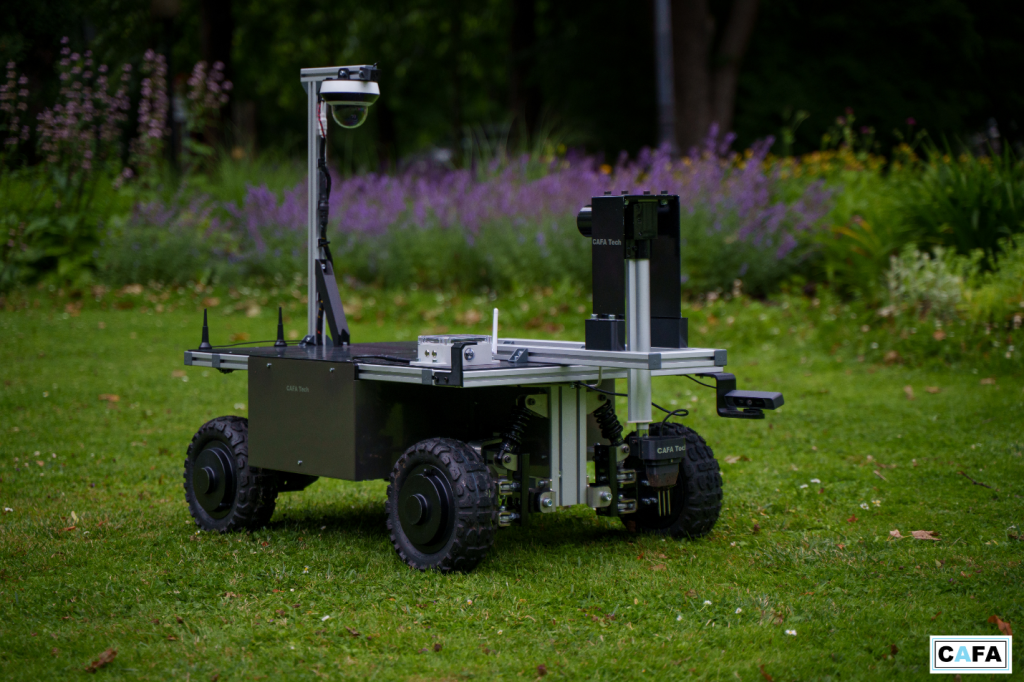
The CAFA UGV platform measures 1100×710×1020 mm (L×W×H) with a total mass of 80 kg, achieving mobility through four 10″ wheels powered by 500 W motors (2000 W combined), enabling a maximum payload capacity of 80 kg while maintaining a ground clearance of 170 mm. The 48 V 20 Ah lithium battery supports extended operation up to four hours cycles, with multiple connectivity options including optical fiber, WiFi, and RF communications for robust data transmission.
A key innovation lies in the sensor suite:
- Four 360° panoramic cameras providing omnidirectional environmental awareness
- An integrated thermal imaging system for non-contact temperature monitoring
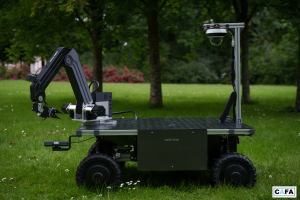
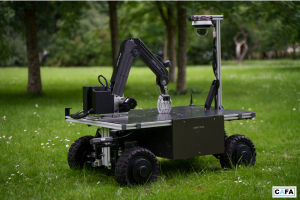
- A 5-DOF robotic manipulator (600 mm reach, 5 kg payload capacity) for physical interaction
The platform’s 1.15m turning radius and 15 km/h maximum speed allow efficient navigation in constrained industrial spaces while maintaining stability during payload operations.
AI-Driven battery diagnostics system
The UGV’s primary operational mode involves autonomous EV battery inspection through a multi-stage diagnostic protocol:
- Thermal Profiling – The onboard thermal camera acquires high-resolution temperature maps of battery compartments, identifying thermal anomalies indicative of cell degradation or thermal runaway risk.
- Computer Vision Analysis – Neural Networks process visual data to detect physical damage.
- Predictive Risk Assessment – A neural network analyses temporal patterns in battery performance metrics, forecasting potential failure events.
The system operates within a closed-loop architecture where the RoboCom control portal generates optimized inspection routes based on facility layouts, while the AI-Center performs distributed computation of sensor data. This dual-layer approach enables real-time decision making while maintaining cloud-based model training with newly acquired fault signatures.
Operational framework
Three distinct control modalities provide operational flexibility:
- Full Autonomy – The UGV executes pre-programmed inspection routines, triggering alerts upon anomaly detection.
- Supervised Autonomy – Human operators review AI-generated risk assessments through the RoboCom web interface, providing final authorization for containment procedures.
- Direct Teleoperation – Low-latency (<150ms) 4G/5G connectivity enables manual control for complex interventions.
Current work under the cPAID initiative focuses on hardening the cyber-physical architecture against adversarial machine learning attacks, particularly model inversion and evasion attacks targeting the diagnostic neural networks.
The platform’s modular design permits rapid adaptation to emerging use cases:
- Smart Grid Maintenance – Autonomous substation equipment monitoring
- Hazardous Material Handling – Robotic sampling in contaminated environments
- Agricultural Automation – Precision pesticide application with computer-vision weed detection and elimination. Soil sampling for data collection.
Ongoing development of multi-agent coordination protocols will enable fleet deployments where UGVs collaboratively map and mitigate distributed risks.
Securing autonomous robotics
The cPAID project addresses critical cybersecurity challenges in autonomous systems like the CAFA UGV. As these platforms become integral to industrial operations, their AI-driven decision-making, sensor networks, and communication systems require robust protection against evolving threats.
The project implements a multi-layered security framework spanning hardware to AI. It begins with comprehensive vulnerability assessments, identifying risks across machine learning models, sensor integrity, and communication channels.
By developing self-protecting robotic architectures, cPAID enables safer deployment of autonomous systems in critical infrastructure. The project’s security methodologies will be adaptable to future robotic applications while maintaining compliance with evolving cybersecurity standards.
Conclusion
The CAFA UGV establishes a new paradigm for autonomous industrial safety systems, demonstrating how embedded AI can transform risk management protocols. Its successful deployment in EV battery monitoring provides a template for expansion into other high-consequence domains requiring reliable machine perception and decision-making.
CAFA Tech (link: https://cafatech.com/) is an Estonian technology company founded in 2015, specializing in 5G drones, robotics, and energy technologies with a focus on advanced batteries. The company creates autonomous systems that replace human labor in dangerous and demanding environments.